
If you have a marketplace project, you are in the right place. Whether you want to build a generalist or a specialised marketplace (by sector, audience or type of product/service), this guide explains how to turn your project into a platform that performs and attracts — from the first market study all the way to the balance between supply and demand.
Why launch a marketplace in 2026?
According to FEVAD’s annual report, French e-commerce reached €196.4 billion in 2025 (+7% year on year), and roughly a third of online product sales already go through marketplaces.
Launching a marketplace in 2026 is a chance to become the reference in your market by aggregating a wide choice of products or services, to reach new customers without having to manage the whole catalogue yourself, and to outsource part of the logistical and commercial complexity. Buyers favour this model for its simplicity and variety, and it also lets you specialise in a niche to stand apart from the large generalist players.
The basics: frequently asked questions before you start
Before we go through each step, let’s set the basics so you have a clear view of the kind of platform we are covering here. These definitions will help you position your idea and think about how to stand out from the players already in place.
What is a marketplace?
A marketplace is a web platform that connects suppliers and buyers. From Vinted to Airbnb, by way of Leboncoin or Amazon, the concept adapts to every sector. The marketplace is the intermediary that makes exchanges easier and transactions safer, earning revenue through commissions, subscriptions or other business models.
What types of marketplace exist (by offering and type of exchange)?
Marketplaces can be classified by what is exchanged and how the transactions happen:
- Physical product sales: new or second-hand goods (e.g. Amazon, Vinted).
- Digital product sales: software, courses, photos, downloadable files… (e.g. Udemy, Envato Market).
- Service sales: services bought directly on the platform or after being matched with the provider (e.g. Fiverr, Doctolib).
- Rental / booking: goods or services rented for a set period, booked online (e.g. Airbnb).
A marketplace can combine several approaches: transaction mode (direct sale or rental/booking), nature of the offering (physical products, digital products or services) and presentation format (provider profile/listing or product/service page).
What marketplace models exist (by who sells to whom)?
- B2C (business-to-consumer): professional sellers → individual buyers (e.g. Amazon, Cdiscount).
- C2C (consumer-to-consumer): individual sellers → individual buyers (e.g. Leboncoin, Vinted). Users often play both roles: they can sell and buy on the same platform.
- B2B (business-to-business): exchanges between companies (e.g. Ankorstore).
These models can be combined with different marketplace types, transaction modes and presentation formats.
What is the difference between a marketplace and an e-commerce site?
An e-commerce site belongs to a single seller: it offers only that seller’s own products or services. A marketplace, by contrast, brings together several independent sellers who publish their offerings and sell them directly to buyers through the platform.
What business models are possible for a marketplace?
The most common one is a commission on transactions, where the platform takes a percentage or a fixed amount on each sale. There is also the subscription model, where sellers pay to access certain features or simply to be listed. Other approaches exist: listing fees, freemium, advertising or lead selling. In many cases several models are combined to maximise profitability. See our detailed section on business models.
Which payment methods are supported on a marketplace?
Several payment methods can be offered to make transactions easier and safer:
- Bank cards (Visa, Mastercard, etc.)
- E-wallets: PayPal, Apple Pay, Google Pay…
- Bank transfers (less frequent, often for large amounts)
- Instalment payments through specialist providers
- Wallets built into the platform, letting users hold a balance online
- Points or internal currencies usable on the platform
To handle these payments securely and in line with regulations (KYC, anti-money-laundering), and particularly for collecting funds on behalf of third parties with a commission-based business model, marketplaces generally go through licensed providers such as Stripe Connect or Mangopay.
Would you rather talk it through?
Tell us about your marketplace project and we will advise you, with no strings attached.
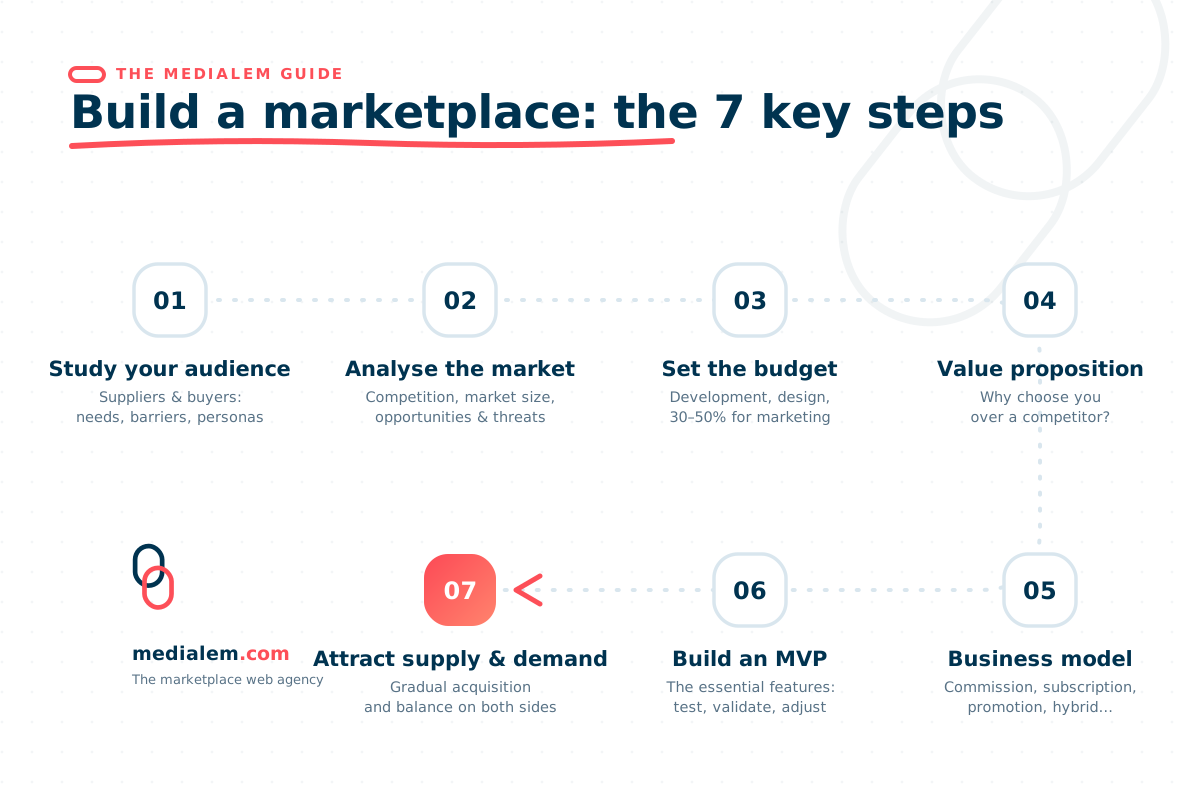
01Step 1Study your audience
Studying your audience has to be continuous, both before and after you build your marketplace. Understanding what suppliers and buyers expect is essential to adjust your offering and make sure your platform gets adopted.
Study current behaviour
- On the supply side: where and how do they currently offer their services or products? Which channels do they use (competing marketplaces, social media, specialist sites, forums…)?
- On the demand side: how do they search for these offerings? Which keywords do they type into search engines? Do they use competing marketplaces or other solutions?
Depending on the type of marketplace, some users can be both suppliers and buyers. On a peer-to-peer rental platform, for instance, a user can be both an owner renting out their home and a traveller renting one.
Build personas to target better
Create typical user profiles (“personas”) representing your ideal buyers and suppliers. For each persona:
- Gender, age, location.
- Interests and buying behaviour.
- Motivations, barriers to using the marketplace you have in mind, and frustrations with existing solutions (lack of flexibility, fees that are too high, complexity, missing features, difficulty finding an offer that matches their needs…).
Talk to your audience to engage them
- Before launch: run qualitative interviews to refine your offering.
- After launch: gather continuous feedback on what exists and suggestions about what users expect, so you can adjust the features.
Build a lasting relationship with your community
Use analytics tools (Google Analytics, Hotjar, surveys, conversion tracking…) to measure engagement and observe buying behaviour on your platform. By staying close to your audience, you will be able to adapt your marketplace and build a real community, which pays off in retention and growth.
02Step 2Study your market and the competition
Before you build a marketplace and launch, take a step back to assess whether your idea answers a real need, then look at how the existing players operate and identify what you could improve or do differently.
Analyse the competition
Study the competitors in your market to understand what makes them successful and where they hit their limits. Analyse their business model, their strategy and their audience to identify what works well and what could be improved. Try their product or service too, to get a better feel for the user experience and the possible improvements. Your goal is to spot the opportunities they have left aside and to work out the best way to stand apart. What will you offer that is better or different? Why would users choose your marketplace over another?
Assess the size of your market
Check that the potential revenue is enough to make your project viable. If the market size is too small and the competition is strong on top of that, then even being optimistic about your ability to win market share, how much could you reasonably expect to generate?
Project your revenue according to your business model (see step 5). For example, assess whether a subscription model can generate enough recurring revenue given the number of potential subscribers. With a commission model, work out whether the estimated business volume will be enough, at the percentage you plan to take, to cover your costs and make you profitable. Do not forget to explore the additional revenue streams you could tap to diversify your income.
Spot the opportunities and threats
- Identify the opportunities your marketplace can exploit (no centralised platform in your niche, user frustration with the current offerings, digitalising a market that is still loosely structured, growing demand for second-hand goods or refurbished products…).
- Anticipate the threats that could affect your project (regulation, technological change, new entrants…).
- Follow market trends to identify the changes and innovations coming next.
Collect useful information about your market
Gather concrete data to assess your project: revenue (Pappers, Societe.com…), headcount (number of employees, types of role via LinkedIn for instance), and web performance including traffic and search engine rankings (SimilarWeb, Ahrefs…).
Collect user reviews of competing platforms through forums such as Reddit, specialist sites (Trustpilot, Avis Vérifiés, Google Reviews…) and social media. Their frustrations can be opportunities for you to stand apart. If Etsy sellers complain about high fees, for instance, a competitor can differentiate itself with a more attractive commission.
Round out your analysis with sector reports (Statista, Xerfi, FEVAD) or by talking to market players at industry events. Make sure your project has real potential before you launch, then keep monitoring actively so you can adapt your strategy as the market evolves.
03Step 3The budget to plan for building a marketplace
The budget depends on the specifics of your project, but here are the items to factor into your estimate:
What does a marketplace cost?
- Developing the web platform: costs range from €1,000 to €5,000 a year for an affordable SaaS solution with good value for money, up to €100,000 or more for bespoke development as a one-off cost. If you want to customise a SaaS solution, allow between €2,000 and €10,000 in fixed fees for the specific integrations.
- Design: visual identity, brand guidelines, UX/UI. A bespoke design can cost between €2,000 and €10,000 depending on complexity.
- Maintenance and support: hosting, updates, bug fixes, new features. With SaaS these are included in the subscription, whereas a proprietary solution needs a dedicated technical team.
- Paying any staff, sales people in particular: depending on your budget and your availability, you can start alone, hire interns or apprentices, or employ full-time sales people. Good sales work is essential, whether through outreach (calling, emailing) or active networking (events, trade shows, LinkedIn, partnerships with other players in the market).
- Transaction fees: not an upfront investment, but a cost to build into your business model. Depending on the payment provider (Stripe, Mangopay…), allow between 1% and 3% of the transaction amount.
- Miscellaneous: the tools you need (CRM, analytics, marketing automation), a domain name, cloud services or specific software. If you want to build a marketplace for free with a CMS such as WordPress, bear in mind that some features or plugins will probably still cost you.
- Marketing!
A closer look at the marketing budget
Let’s be clear: even if you built the perfect marketplace, without marketing your online marketplace will stay invisible. Plan to allocate at least 30% to 50% of your overall budget to acquisition. As a rough guide, here are a few marketing cost items:
- SEO (organic search): between €200 and €1,000 a month, covering technical optimisation, content creation and link building (backlinks, guest posts).
- Paid advertising (Google Ads, Facebook Ads, LinkedIn Ads…): between €500 and €2,000 a month, or more depending on your goals and how competitive the market is.
- Email marketing: budget for the tools (€10 to €50 a month) plus campaign production (€100 to €1,000 a month depending on frequency and complexity).
- Influencers and partnerships: highly variable costs, from a few hundred to several thousand euros depending on the partner’s reach and profile.
Do not forget the costs of producing content, in house or outsourced: videos, visuals, newsletters, infographics or blog posts. Email marketing, for example, is not just the cost of the tools: it also includes writing the emails and creating the visuals.
What matters is testing and continuously optimising, with proper performance tracking in place to maximise your return on investment. You can start with a small budget, and if a campaign performs well, increase it!
An overall budget to get started: struggling to size your budget? Allow at least €15,000–€30,000 a year for a solid launch. Less is possible, but slower and riskier. Execution remains the key factor: good marketing and an effective strategy can make up for a smaller budget.
04Step 4Define your value proposition
Your value proposition is what makes your marketplace unique and lets it stand apart from the competition. It has to answer one question clearly: why would a user choose your platform over another?
How do you define your value proposition?
- Identify your audience’s needs: what problems do your future users run into, and how can your marketplace answer them in a unique, innovative way?
- Identify what genuinely sets you apart: what are the weak points of the existing solutions, and how can you offer an approach that is more effective or better suited to your target market?
- Put together a clear, striking promise: one concise sentence that states your added value directly. For example: “The first marketplace connecting local artisans with city dwellers looking for authenticity.” or “The first platform that makes long-term rental easy, with secure payments and simplified contract management.”
- Test and validate your proposition: before adopting it for good, put it in front of your audience to check that it speaks to them and matches their real needs.
- Carry that value proposition through all your communication: website, ads, emails… it has to be visible and consistent at every touchpoint with your users.
Your value proposition is not set in stone: it can evolve with user feedback and strategic adjustments. Review it regularly to stay relevant and competitive.
05Step 5Choose a business model that fits
Your marketplace business model determines how you will generate revenue and make the platform viable. You need a model suited to your audience and your market.
How does a marketplace make money?
| Business model | Description | Advantages | Drawbacks |
|---|---|---|---|
| Commission on transactions | A percentage is taken on each sale made through the platform (e.g. Airbnb, Vinted). | No upfront cost for sellers | Low revenue if sales are few |
| Subscription | Users pay a recurring fee to access the marketplace or certain features (e.g. LinkedIn Premium, some freelance sites). | Recurring, predictable revenue | Can slow down early user acquisition |
| Listing fees | Suppliers pay to publish a listing. Often applied partially, mainly to professionals or certain categories (e.g. Leboncoin). | Generates revenue even without a transaction | Can limit the number of available listings |
| Promotion fees | Payment to boost the visibility of a listing that is already online (e.g. Leboncoin, Upwork). Often used alongside another model. | Generates revenue even without a transaction | Needs volume |
| Advertising and partnerships | Monetisation through sponsored listings or partnerships (Amazon, eBay, Leboncoin…). | No direct cost for users | Needs heavy traffic to attract advertisers |
| Hybrid business model | A combination of several models to maximise revenue and fit the audience. | Flexibility and diversified revenue | More complex to run and optimise |
How do you choose your business model?
- Assess your audience: what can your users afford to pay? Which models are most accepted in your sector?
- Study the existing models: which business models do similar marketplaces use? What are their strengths and weaknesses? Can you offer something more competitive?
- Test and adjust: you can change course based on user feedback and early performance.
Your business model has a direct impact on your marketplace’s strategy and profitability. Make sure it is viable, attractive and scalable.
06Step 6Develop a first version of your marketplace
You do not need a complex, expensive platform from day one. By developing an MVP (minimum viable product), you create a first version of your marketplace with only the essential features, enough to test your market and gauge user interest. This approach lets you adapt quickly to early feedback and refine your platform step by step.
Why start with an MVP?
- Optimise development: avoid building features your users neither expect nor will use.
- Reduce risk: validate your concept with a limited investment before committing significant resources.
- Iterate quickly: adjust your platform based on feedback from the first users.
- Better time to market: launch a working version quickly rather than waiting months for a “perfect” product.
The essential features of a marketplace MVP
- User sign-up / sign-in
- Creating and managing offerings / listings
- Basic search and filtering
- Messaging between users
- Secure payments (if your model involves transactions)
Which solutions can you use to build your marketplace?
- Turnkey solutions: suited to a quick start, they let you build a marketplace without complex development (e.g. Medialem, Sharetribe, Kreezalid).
- Bespoke development: for a fully customised platform, but more expensive and slower to build.
- Hybrid solutions: an existing base plus specific development to answer particular needs.
Comparing marketplace solutions
| Solution | Price | Features and specifics |
|---|---|---|
| Medialem | From €189/month | Flexible SaaS solution for sales, rentals, services and classified ads. Secure hosting, transaction management, payment module, responsive customer support. Local expertise and compliance with French regulations. |
| Cocolabs | On request | Specialised in service marketplaces with booking and payment management. Not suited to selling physical products. |
| Wizaplace | On request | Turnkey solution for B2B marketplaces, with prebuilt modules. Less flexible to customise. |
| Kreezalid | From €249/month | Suited to C2C and B2B marketplaces, with basic features and little customisation. |
| Origami Marketplace | €500/month + set-up fees | Flexible solution for sales, rentals and services. Standardised approach. |
| Sharetribe | From $99/month | Ideal for launching a small marketplace quickly. Limited for complex projects. |
| CS-Cart | Basic version from €49 | Perpetual licence with little customisation flexibility, requiring development expertise. |
Medialem, a flexible solution for your marketplace
If you do not have the technical skills in house, a specialist solution such as Medialem can support you in building your marketplace. Thanks to a modular architecture, we cover a range of platform types:
- Multi-vendor e-commerce marketplaces
- Booking platforms
- Directories or classified ad sites with subscriptions
- Platforms with an advanced matching algorithm
Every project can be adjusted to your specific needs to guarantee a scalable, well-suited solution.
Bespoke or SaaS? Let's compare for your project.
We show you our platform in real conditions and price up what you need.
07Step 7Attract and balance supply and demand
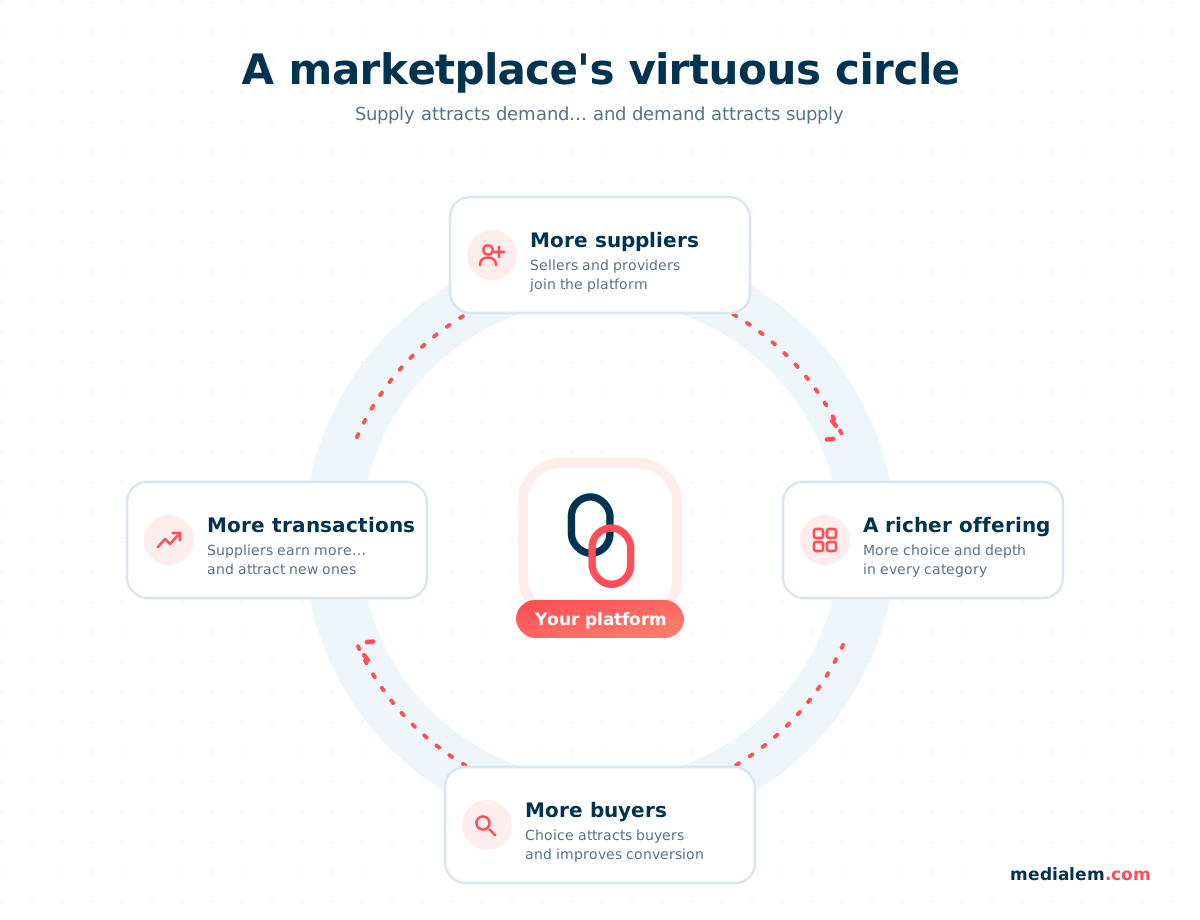
Launching and building a marketplace is not enough. At the start it is unknown and, without specific action, it will stay empty. What is more, improving conversion requires a balance between supply and demand: without supply, demand will not come and/or will not convert; and without demand, suppliers will not be interested in starting or continuing to publish their offerings with you.
Work the right acquisition channels from launch
- SEO (organic search): SEO takes time to produce results but brings lasting visibility. Structure your site, optimise your content and build quality backlinks.
- SEA (paid search): Google Ads brings visitors in quickly by targeting specific queries. Set up solid conversion tracking so you can adjust your campaigns and maximise return on investment.
- Social media advertising: Meta Ads, LinkedIn Ads and TikTok Ads offer precise targeting by interest and online behaviour. As with SEA, track your conversions carefully so you know which campaign works.
- Organic social media: create engaging, useful posts and try for viral content to attract an audience naturally and interact with the community.
- Influencers: working with influencers can increase visibility and build trust. Smaller influencers, more affordable, are often more effective in niche markets, where their closeness to the community makes the difference.
- Other levers: specialist forums, physical events (trade shows, conferences), press relations, word of mouth… depending on what is relevant to your market.
Direct outreach: effective in the right cases
In some cases, particularly in B2B or when building a service marketplace, direct outreach can be a good way to kick-start supply and demand. It means identifying company databases or finding professionals online, then contacting them directly to present your platform. These conversations bring in the first qualified users, help you understand their needs and identify what is holding them back from signing up, all while refining your value proposition.
Focus on a niche to maximise impact
An effective strategy is to start with a specific niche before gradually widening your offering. Focus first on:
- One product/service category: on a baby products marketplace, for instance, first attract pushchair sellers, then target parents looking for pushchairs, before extending to other categories.
- One limited geographic area: for a home services platform, it is better to focus on a city or a region first, attract enough providers within a defined area, then run targeted campaigns at customers in those places.
This approach gives you a denser offering along one specific dimension (category, attribute, location), which improves conversion and the user experience.
Optimise the acquisition cycle
Making a marketplace work is not just about attracting visitors. Three big stages need optimising:
- Acquisition: working the channels that bring in the first users (suppliers and buyers).
- Conversion: making sure that once they are on the platform, users take action (sign up, transact, publish a listing…).
- Retention: encouraging users to come back, republish listings, renew subscriptions or buy again.
See also our article on who to attract first on a marketplace to go further on this strategy, and bear in mind that acquiring suppliers and buyers is a continuous process. The goal is to create a virtuous circle where supply attracts demand and demand attracts supply.
A closer look at the legal side of marketplaces
What legal status should a marketplace have?
There is no specific legal status for marketplaces in France. They can be run under various statuses (sole trader, SAS, SARL…) depending on the project and its needs.
Essential legal obligations
- Legal notice and terms of use / sale: a marketplace must clearly display the operator’s identity (company name, registration number, contact details) and make terms of use and terms of sale available. These documents set out the roles and responsibilities of users (sellers, buyers) and include essential information such as sellers’ tax obligations and invoicing rules.
- Data protection (GDPR): marketplaces collecting personal data must comply with the GDPR and guarantee users their rights (access, rectification, erasure). A clear privacy policy has to be in place. These obligations are generally handled by the technical solution or the provider, but the project owner must make sure they are met.
Specific points depending on the marketplace’s activity
Depending on your sector, specific regulations may apply: managing tourist tax (accommodation rental), strict health standards (food sales), licences (financial or health services), or reporting sellers’ income to the tax authorities (peer-to-peer sales). These obligations vary from market to market and change regularly. Check what applies to your activity to keep your marketplace compliant.
Tax and reporting obligations
Depending on your marketplace’s model, certain tax obligations may apply. For example, a marketplace that takes a commission and facilitates payments must report individual sellers’ income to the tax authorities once it exceeds €3,000 a year or 20 transactions. Since the e-commerce VAT reform, marketplaces facilitating B2C transactions are required to collect and remit VAT for sellers located outside the European Union, particularly for imported goods and digital services.